

Table of Contents
- Two CRMs, Two Operating Models
- Salesforce in 2026
- Agentforce: Built for Enterprise Complexity
- HubSpot in 2026
- Agentforce vs Breeze
- What a 10-Person Sales Team Really Pays
- Which Platform Fits Your Team?
- Frequently Asked Questions
- The Straight Answer
HubSpot vs Salesforce often gets reduced to one tidy argument.
HubSpot is easier.
Salesforce is more powerful.
That shortcut misses the expensive part.
Both platforms can support serious revenue teams. They simply ask for different levels of budget, ownership, and technical support.
Salesforce gives organizations more room to customize complex processes. HubSpot gives teams a shorter path from purchase to daily use.
The right choice depends on how your business runs, who will own the platform, and how quickly the team needs to see value.
1. Two CRMs, Two Operating Models

Salesforce remains the enterprise heavyweight.
It is built for organizations with complex sales processes and large data environments.
Dedicated technical teams can shape the platform around highly specific workflows.
HubSpot has moved well beyond its old “lighter CRM” reputation.
Marketing, sales, service, and reporting can all work from one connected platform.
That makes HubSpot a serious option for growing and mid-market teams. They get more capability without turning CRM management into a full-time internal project.
This comparison is no longer about a basic CRM versus an enterprise one.
It is about two capable platforms built around different operating models.
AI raises the stakes.
It now touches prospecting, sales coaching, forecasting, service, and reporting.
A poor platform fit creates more than an awkward workflow. It creates expensive workarounds at scale.
2. Salesforce in 2026
Agentforce is the clearest signal of where Salesforce is heading.
The Spring ’26 release added several major updates:
- Sales Workspace brings agents, analytics, and predictive insights into one place for sales reps.
- Agentforce Voice supports AI-powered conversations across phone, web, and mobile.
- Agentic Enterprise Search connects agents with context across more than 200 external data sources.
Salesforce is building a CRM where AI participates in the work. It can research, prioritize, summarize, recommend, and act across connected systems.
Some Agentforce features have also moved into lower-cost Salesforce suites.
Entry-level teams can access tools such as AI record summaries and email drafting without starting at Enterprise.
The deepest capabilities still sit higher up the pricing ladder.
Advanced customization, conversation intelligence, predictive tools, and broader Agentforce deployment need more investment. They also need stronger governance.
Salesforce can do a lot. It expects the business to own the setup properly.
3. Agentforce: Built for Enterprise Complexity
Agentforce is Salesforce’s platform for building and deploying AI agents.
The Atlas Reasoning Engine gives agents the context to make decisions and take action inside Salesforce and connected systems.
What Agentforce Can Do
Agentforce Builder gives teams one place to build, test, and deploy custom agents. Low-code tools support faster setup. Pro-code options leave room for deeper customization.
Always-On Prospecting finds, enriches, and prioritizes leads using Salesforce data and external signals.
Account Management AI brings account history, third-party data, and conversation insights into a clearer view for sales reps.
Agentforce Voice handles phone conversations and routes complex cases to a person when needed.
Conversation Intelligence records and analyzes sales calls. It surfaces deal signals and coaching opportunities.
Agentforce for Marketing supports campaign creation, journey orchestration, and real-time personalization.
It runs through Marketing Cloud Next, a separate product starting at approximately $1,500 per month.
The value is flexibility. Teams can build AI around highly specific processes and data.
That flexibility needs ownership. RevOps, IT, or a dedicated Salesforce admin will usually play a central role.
With the right support, Agentforce can create a serious advantage. Without it, the demo becomes much easier to love than the day-to-day.
4. HubSpot in 2026
HubSpot has focused on making sophisticated CRM work easier to adopt.
Its main advantage is the connected data model. Marketing, sales, and service teams can work from the same customer record and activity timeline.
Email engagement, page visits, forms, sales activity, and customer conversations stay attached to one shared view.
That gives teams less reconciliation and fewer debates about which system holds the right answer.
HubSpot also shortens the path to productivity.
Sales reps can build sequences and manage activity without a long setup project. Marketing teams can adjust workflows without waiting on technical support for every change.
That speed has real value. CRM capability only pays back when people use it consistently.
HubSpot Enterprise also supports more complex requirements, including:
- Custom objects
- Advanced permissions
- Predictive lead scoring
- Conversation intelligence
- Deeper reporting
HubSpot has grown past the “easy option” label. It now gives serious teams more power without demanding the same level of internal administration.
5. Agentforce vs Breeze
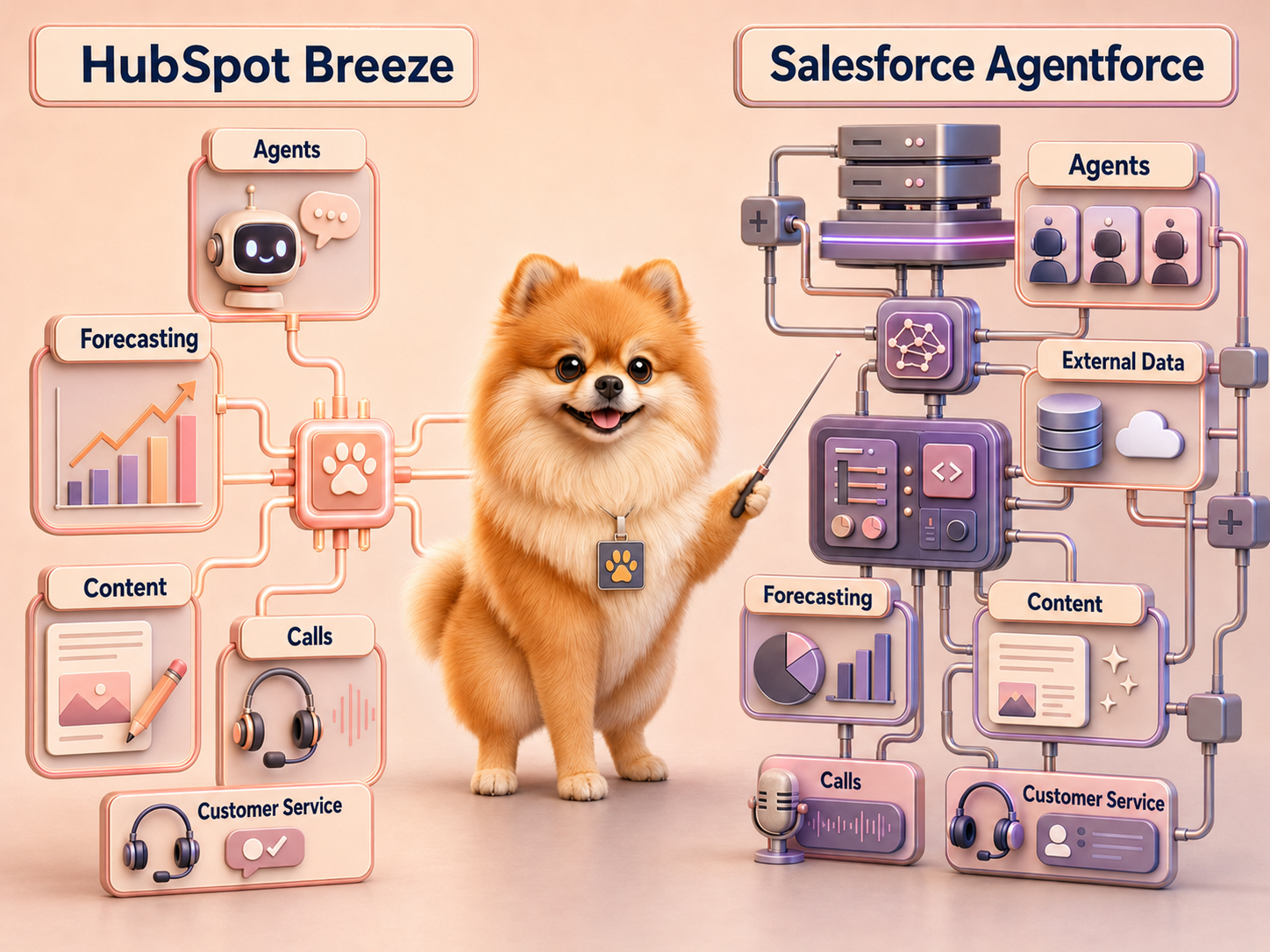
Salesforce and HubSpot are solving different AI problems.
Salesforce Agentforce: More Room to Build
Agentforce is designed for complex workflows and custom agents.
Teams can connect multiple data sources, deploy agents across channels, and build around highly specific processes.
That depth needs governance. Someone has to own access, data quality, testing, and ongoing performance.
HubSpot Breeze: A Shorter Path to Use
Breeze is designed to work inside the CRM with less setup.
Breeze Copilot is available across HubSpot plans. It summarizes records, surfaces context, and supports everyday work.
Breeze Agents handle more specialized tasks:
- Prospecting Agent researches accounts and drafts outreach.
- Content Agent creates marketing content.
- Customer Agent handles support questions and escalates complex cases.
Some Breeze features use HubSpot Credits. Included credits depend on the account’s highest subscription tier. Unused credits expire each month.
The AI Trade-Off
Both platforms support:
- AI-assisted email drafting
- Predictive scoring on higher tiers
- Conversation intelligence
- AI prospecting
- Revenue forecasting
Agentforce gives technical teams more room to customize. Breeze gives revenue teams a faster route to usable AI.
The better option depends on what your team can support after implementation.
6. What a 10-Person Sales Team Really Pays
HubSpot and Salesforce look closer at the mid-market level than many teams expect.
The gap grows when enterprise requirements, implementation support, AI usage, and separate marketing products enter the picture.
Approximate Annual Platform Cost
| Platform and plan | Approximate annual cost for 10 users | Additional cost to consider |
|---|---|---|
| Salesforce Pro Suite | $12,000 | Add-ons and implementation support |
| Salesforce Enterprise | $21,000 | Consulting, admin ownership, and usage-based AI |
| HubSpot Sales Hub Professional | $12,000 | Approximately $1,500 onboarding |
| HubSpot Sales Hub Enterprise | $18,000+ | Approximately $3,500 onboarding |
Salesforce Marketing Cloud Next starts at approximately $1,500 per month as a separate product.
These figures are a starting point. Pricing can change, and the final contract depends on seats, add-ons, usage, contacts, and support.
The invoice is only the first layer.
Implementation time matters. So do admin work, training, integrations, reporting setup, and process cleanup.
Ask these questions before comparing totals:
- Who will own the platform?
- How much configuration will it need?
- Which integrations are essential?
- How quickly can the team become productive?
- What will AI usage cost at your expected volume?
- Will you need outside support to keep it running?
A cheaper subscription can create a more expensive operation. A higher platform cost can still deliver better value when it removes friction the team feels every day.
7. Which Platform Fits Your Team?
Feature tables cannot make this decision for you. Team readiness can.
Choose Salesforce When
- Your sales process has complex stages, territories, approvals, or compliance requirements.
- RevOps, IT, or a Salesforce admin can own the platform.
- Deep customization is central to the business.
- Multiple systems and data sources need to work together.
- Your team can support custom AI agents and ongoing governance.
Salesforce rewards organizations that are ready to build around it.
Running an agency or managing multiple client accounts? Our HubSpot vs GoHighLevel comparison covers that operating model.
Choose HubSpot When
- Marketing, sales, and service need one shared customer record.
- The team needs to get productive with less configuration.
- Adoption speed carries more weight than deep technical customization.
- AI needs to support the funnel quickly.
- Internal admin resources are limited.
HubSpot rewards teams that need serious capability with less operational drag.
Considering a lower-cost marketing platform too? Our HubSpot vs Brevo comparison goes deeper.
8. Frequently Asked Questions
What is the biggest difference between HubSpot and Salesforce in 2026?
Salesforce gives organizations more customization and control across complex processes.
HubSpot gives teams a more connected experience across marketing, sales, and service. It usually takes less time and technical support to adopt.
Agentforce offers more room to build. Breeze offers a shorter path to use.
Is Salesforce more expensive than HubSpot?
At Enterprise level, Salesforce usually carries the higher total cost.
The seat price is only part of it. Implementation, consulting, admin ownership, add-ons, and AI usage can widen the gap.
At SMB and mid-market levels, the subscription prices can look much closer.
Does Salesforce include AI on entry-level plans?
Salesforce includes selected AI features across lower-cost suites, including tools such as record summaries and email drafting.
Advanced Agentforce capabilities still require higher tiers, add-ons, or usage-based pricing.
Can HubSpot support enterprise teams?
Yes, when the organization values adoption, connected customer data, and a lighter admin burden.
HubSpot Enterprise supports custom objects, advanced permissions, predictive lead scoring, conversation intelligence, and deeper reporting.
Salesforce remains stronger when extensive customization and complex multi-system architecture drive the decision.
Which is the better enterprise CRM?
Salesforce is the stronger fit for enterprises with dedicated technical resources and highly customized processes.
HubSpot is often the better fit for growing and mid-market teams that want enterprise-level capability without building a large admin function around the CRM.
9. The Straight Answer
Salesforce gives organizations more room to build. That room comes with higher ownership demands.
HubSpot gives teams a shorter path to adoption. The trade-off is less freedom to customize every layer.
The expensive part starts after the contract is signed.
It shows up in admin hours, messy integrations, weak adoption, and processes the platform was never designed to support.
Choose the CRM your team can run well. That decision will create more value than the longest feature list.
THE WRONG CRM GETS EXPENSIVE AFTER THE CONTRACT IS SIGNED.
Show us your sales process, team structure, and support capacity. We’ll show you which platform fits, what it will take to run, and where hidden costs could appear.